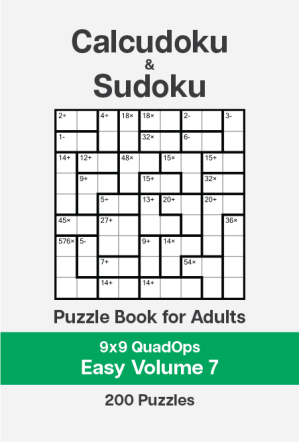
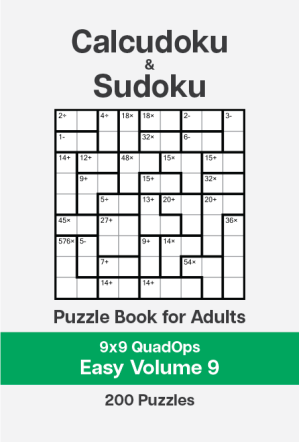
What’s inside:
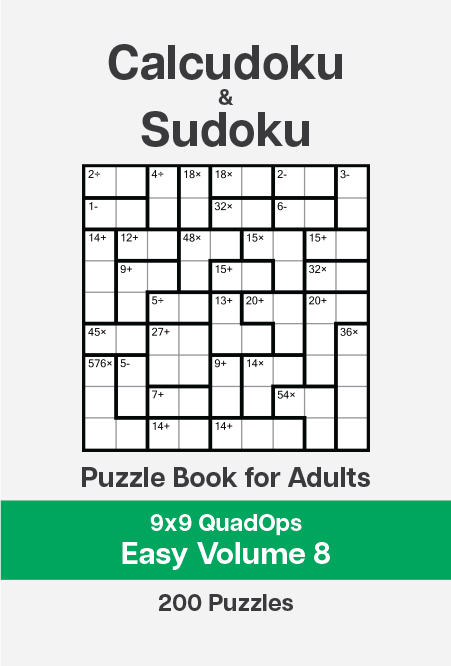
- 200 puzzles: 100 9×9 Calcudoku Puzzles; 100 Sudoku Puzzles; Includes solutions/li>
- In-depth strategies and techniques: Fully explained strategies with examples
User-friendly design!
- Large print: Enjoy one 4″x4″ Calcudoku puzzle per page
- Compact size: 6×9 format
How Logic Puzzles Strengthen Pattern Recognition Skills
Pattern recognition is one of the most important thinking skills used in everyday life. From identifying trends and spotting inconsistencies to recognizing relationships between pieces of information, the ability to see patterns helps people make sense of complex situations. Logic puzzles provide a practical and enjoyable way to exercise this skill. Every Sudoku or Calcudoku puzzle presents a collection of clues that must be examined, interpreted, and connected in order to uncover the correct solution.
Sudoku is built around recognizing numerical relationships within rows, columns, and grids. Solvers learn to identify missing values, detect restrictions, and spot opportunities that may not be immediately obvious. Calcudoku develops pattern recognition in a different way. In addition to considering number placement, solvers must evaluate how groups of cells interact through mathematical operations. This creates another layer of relationships that must be analyzed and understood. Both puzzle types encourage careful observation and reward the ability to recognize meaningful connections.
Finding Order Within Complexity
One reason logic puzzles remain so satisfying is that they transform a seemingly complex challenge into a series of recognizable patterns. What initially appears confusing gradually becomes more manageable as relationships emerge and possibilities narrow. This process of discovery is a central part of the puzzle-solving experience. Rather than relying on guesswork, solvers learn to identify clues that reveal the next logical step forward.
A puzzle book that combines Sudoku and Calcudoku offers two complementary approaches to pattern recognition. Sudoku focuses on deduction through placement and elimination, while Calcudoku introduces numerical structures that require additional analysis. Easy puzzles make these patterns easier to identify without removing the satisfaction of solving. As a result, each puzzle becomes an engaging exercise in observation, reasoning, and logical discovery, providing both entertainment and a rewarding opportunity to strengthen valuable thinking skills.
“`
Give this Calcudoku and Sudoku puzzle book a try!