What Is Calcudoku? Learn the Rules and Start Solving Today
Calcudoku is a fun logic puzzle that extends beyond the traditional confines of Sudoku by integrating math into the mix. The game was invented by Japanese math teacher Tetsuya Miyamoto in order to help his students learn math. The game is also known as “KenKen” of Mathdoku. The goal of each Calcudoku puzzle is to fill in the grid with the digits 1 through N (where N is the number of rows or columns in the grid) such that no column or row contains the same number twice. While a number may repeat within a block, the numbers within the block must produce the result of the mathematical operation appearing in the block. The game is a test of both numerical skill and logical reasoning, offering a rich problem-solving experience that can be stimulating for those seeking a challenge beyond traditional puzzles.
The Basics
The Grid: Calcudoku is played on a square grid consisting of an equal number of rows and columns. The smallest grid is typically 4×4 and the largest is 9×9. However, the most common sizes are 5×5 and 6×6 grids.
The Blocks: The blocks are groups of squares over which an arithmetic operation will apply. Unlike Killer Sudoku, numbers may repeat within a block as long as they are not in the same row or column.
Arithmetic Clues: In each block is a numerical value followed by an arithmetic sign (+ – x ÷). The arithmetic operation will apply to the numbers you fill in each block with. The result of the operation must be the numerical value specified.
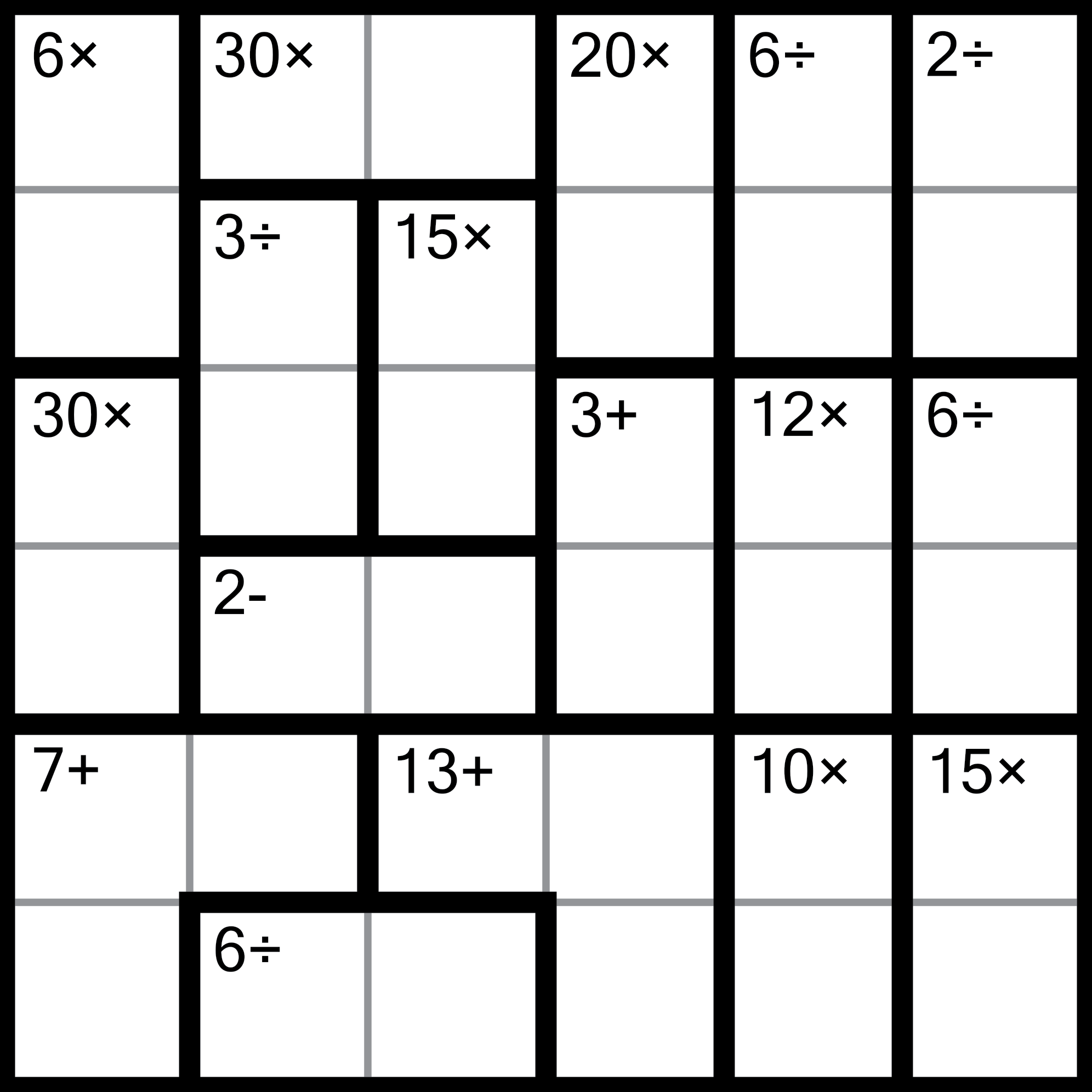
Example 6×6 Calcudoku Puzzle Grid:
Calcudoku Rules
In a Calcudoku puzzle, you’ll be presented with an NxN grid. You must fill out the grid using the numbers 1 to N and the following rules must be adhered to:
- Use all digits 1 to N in each row and column
- No digit may repeat within a row or column
- The numbers within a block must result in the numerical value specified in the block when the arithmetic operation is applied
- A digit within a block may repeat as long as it does not repeat in the same row or column
- The puzzle is solved when all cells in the grid are filled in without violating any rules
Useful tips
- Pencil and eraser are your friend! Make sure you use a sharp pencil with an eraser. When you first start solving Calcudoku puzzles, you are likely to make mistakes. Even seasoned Calcudoku puzzlers make mistakes.
- Pace yourself Accuracy is more important than speed. The more accurate you are as you solve the puzzle, the less likely you are to makes mistakes. If you make a mistake, sometimes you can recover easily. However, if the mistake is one you don’t catch until the puzzle is almost complete, you may need to backtrack all the way to the beginning. And don’t worry, as you solve more Calcudoku puzzles, you will get better at applying your logic and your speed will organically increase.
- Approach each puzzle systematically Start with the obvious and move to the more difficult parts of the puzzle. For instance, it is better to start with a row, column, or sub-grid that is mostly complete than one with a single number. Or starting with a number that occurs frequently in the puzzle already rather than a number that occurs once.
- Practice, practice and practice! Calcudoku is about applying math, logic, and problem solving skills. These are skills we all have on some level, but new skills take time to develop. The more you practice and play Calcudoku puzzles, the better you will get at accessing the logic you’ve learned and applying that logic to solving them regardless how difficult.
- Use a notation system As you begin to solve Calcudoku puzzles, find a useful notation system that works for you. Then as you play, use this notation system to keep track of all the decisions you make as you apply your logic and math skills.
Basic Calcudoku Strategies
Many of the same logical techniques used in Sudoku can also be used in Calcudoku, but the mathematical clues provide additional information that can help you narrow down possibilities more quickly.
Solve Single-Cell Cages and Two-Cell Cages First
Start with the easiest cages. Single-cell cages can be filled immediately, and small two-cell cages often have only a few possible combinations. For example, in a 4×4 puzzle, a cage totaling 3 can only contain the numbers 1 and 2. Once you know the possible values, the surrounding rows and columns will help determine where each number belongs.
Eliminate Possible Candidates
Use the numbers you’ve already placed to eliminate possibilities elsewhere in the puzzle. Every completed cell provides new information, especially for neighbouring cages and for cells that share the same row or column. Because numbers cannot repeat within a row or column, many potential combinations can often be ruled out immediately.
Use Cage Totals to Your Advantage
As puzzles become more difficult, pay closer attention to the relationships between the numbers in each cage. Larger multiplication cages can often be approached by listing the possible factor combinations that produce the target value. Likewise, addition cages have a limited number of number combinations that can reach a particular total without repeating values in the same row or column. Working through these possibilities can quickly eliminate incorrect candidates.
For harder puzzles, it can be useful to pencil in candidate numbers just as you would in Sudoku. Consider every possible combination that satisfies a cage’s operation and target value, then remove candidates as additional information becomes available. Every number you place affects other cells in the puzzle, and those knock-on effects are often what lead to the next breakthrough.
Find detailed strategies in The Puzzle Doctor Calcudoku books!
Calcudoku and Sudoku Puzzle Book Series
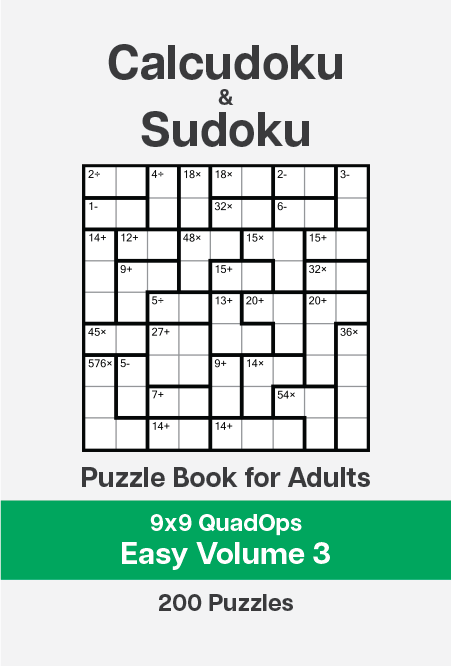
Enjoy two distinct puzzle experiences in a single book. This series combines classic Sudoku with 9×9 Calcudoku puzzles that use all four mathematical operations, creating a diverse collection of logic and number challenges. With 10 volumes available for each difficulty level, puzzle enthusiasts have plenty of opportunities to test their skills and discover new favorites.
6×6 Calcudoku Addition-Only Series
Designed to emphasize logical deduction over complex arithmetic, these 6×6 addition-only Calcudoku puzzle books are an excellent choice for solvers who prefer a gentler challenge. The compact grid size keeps puzzles approachable, while the addition-only cages allow you to focus on mastering Calcudoku techniques and solving strategies. Whether you’re new to Calcudoku or simply looking for a more relaxing puzzle experience, this series offers plenty of enjoyable puzzles to explore.
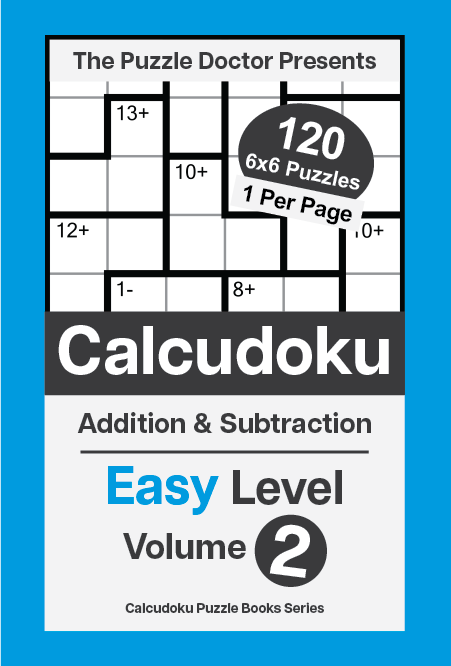
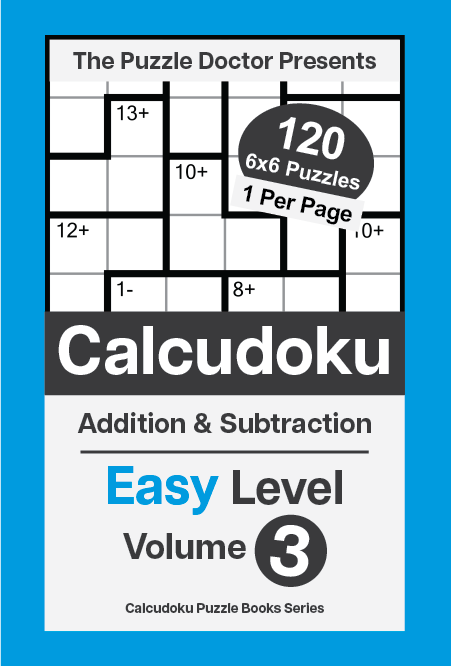
6×6 Calcudoku Addition and Subtraction Series
Featuring a mix of addition and subtraction cages, these 6×6 Calcudoku puzzle books offer greater variety while remaining accessible to a wide range of solvers. The combination of two operations encourages careful deduction and flexible thinking, creating engaging puzzles that are both approachable and rewarding to solve.
6×6 Calcudoku QuadOps Series
Built around the complete set of Calcudoku operations, this 6×6 series offers a broad selection of puzzle styles and solving patterns. Easy volumes provide a gentle introduction to multi-operation puzzles, Medium volumes increase the level of deduction required, and Hard volumes deliver more demanding grids for solvers seeking a greater test of logic and arithmetic reasoning.